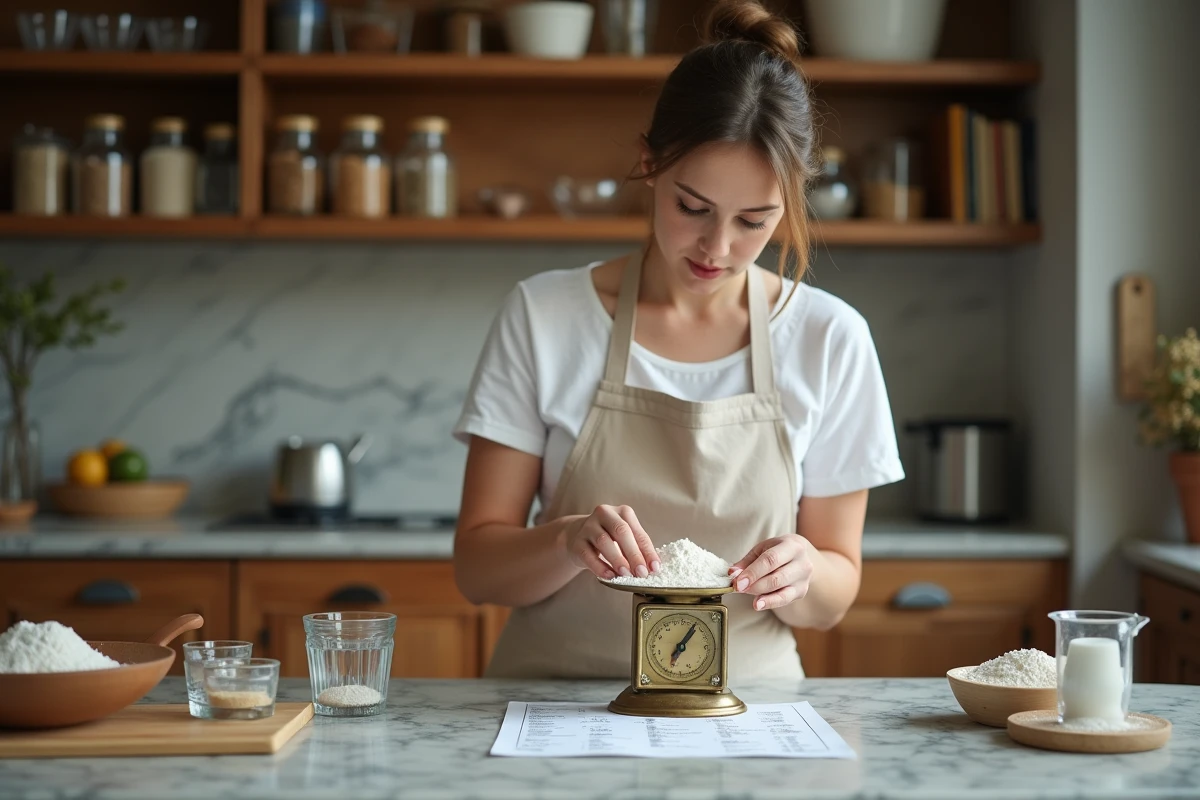
You are following a recipe that calls for 200 g of flour, but you only have a graduated measuring cup in milliliters. The reflex would be to consider that grams and milliliters are the same. For water, yes. For flour, sugar, or oil, this approximation can ruin a pancake batter or a cake.
Why density changes everything in a gram to liter conversion
A liter of water weighs exactly one thousand grams. This simple reference works because the density of water is 1 g/mL. Each ingredient has its own density, and that’s where the errors begin.
Flour, for example, is much lighter than water at equal volume. Fill a measuring cup with 100 mL of flour: you get about 60 g, not 100 g. Do the same with honey: you will far exceed 100 g. The density of each ingredient determines the actual weight of a given volume.
The formula to remember is straightforward: volume (in mL) = mass (in grams) divided by density (in g/mL). To effectively use the gram to liter conversion table, you must always check the density of the ingredient in question, not just apply the water ratio to everything that comes along.
A point often overlooked: temperature slightly modifies the density of liquids. Warm melted butter does not have exactly the same density as hot melted butter. In baking, where precision counts to the gram, this variation can be enough to change the texture of a cream or ganache.

Gram-liter conversion table for common cooking ingredients
Rather than looking up the density of each food for every recipe, a reference table saves considerable time. Here are the most useful benchmarks, based on standard food densities.
| Ingredient | Approximate Density (g/mL) | Weight of 100 mL |
|---|---|---|
| Water | 1.00 | 100 g |
| Whole milk | 1.03 | 103 g |
| Oil (olive, sunflower) | 0.92 | 92 g |
| Wheat flour | 0.55 – 0.65 | 55 to 65 g |
| Granulated sugar | 0.85 | 85 g |
| Thick cream | 1.00 – 1.05 | 100 to 105 g |
| Honey | 1.40 | 140 g |
Oil always weighs less than water at equal volume, while honey weighs significantly more. These are the two most common extremes in cooking. Keeping them in mind avoids most measurement errors.
For flour, the density varies depending on how compacted it is. Sifted flour takes up more volume than flour packed in its bag. Before measuring flour with a measuring cup, aerate it with a spoon for a more reliable result.
Level or heaping spoon: a difference that recipes do not specify
You may have noticed that a recipe asks for “a tablespoon of cocoa” without specifying whether it should be level or heaping? The difference between a level spoon and a heaping spoon can double the amount of a powdered ingredient.
Nutritional databases like USDA FoodData Central explicitly distinguish between “level tablespoon” and “heaping tablespoon.” The Ciqual database from ANSES, updated in 2024, provides densities for hundreds of foods and also uses standardized portions.
In practice, remember these benchmarks for spoon conversions:
- A level tablespoon contains about 15 mL of liquid, which is 15 g of water, but only 8 to 10 g of flour
- A level teaspoon corresponds to 5 mL, which is 5 g of water or about 3 g of flour
- A heaping spoonful of powdered sugar or cocoa can contain double the amount of the level version, a difference sufficient to alter the taste of a dessert
In baking, always adopt the level spoon unless otherwise indicated. The level spoon is the reliable reference measurement for any recipe requiring precision.
The trap of Anglo-Saxon recipes
American or British recipes use the “cup,” which is about 240 mL. A “cup of flour” does not weigh 240 g but rather 130 to 150 g depending on the type of flour and how compacted it is. Converting a cup to grams without considering the density yields results that are very far from the original recipe.
Quick method to convert without a scale or table in sight
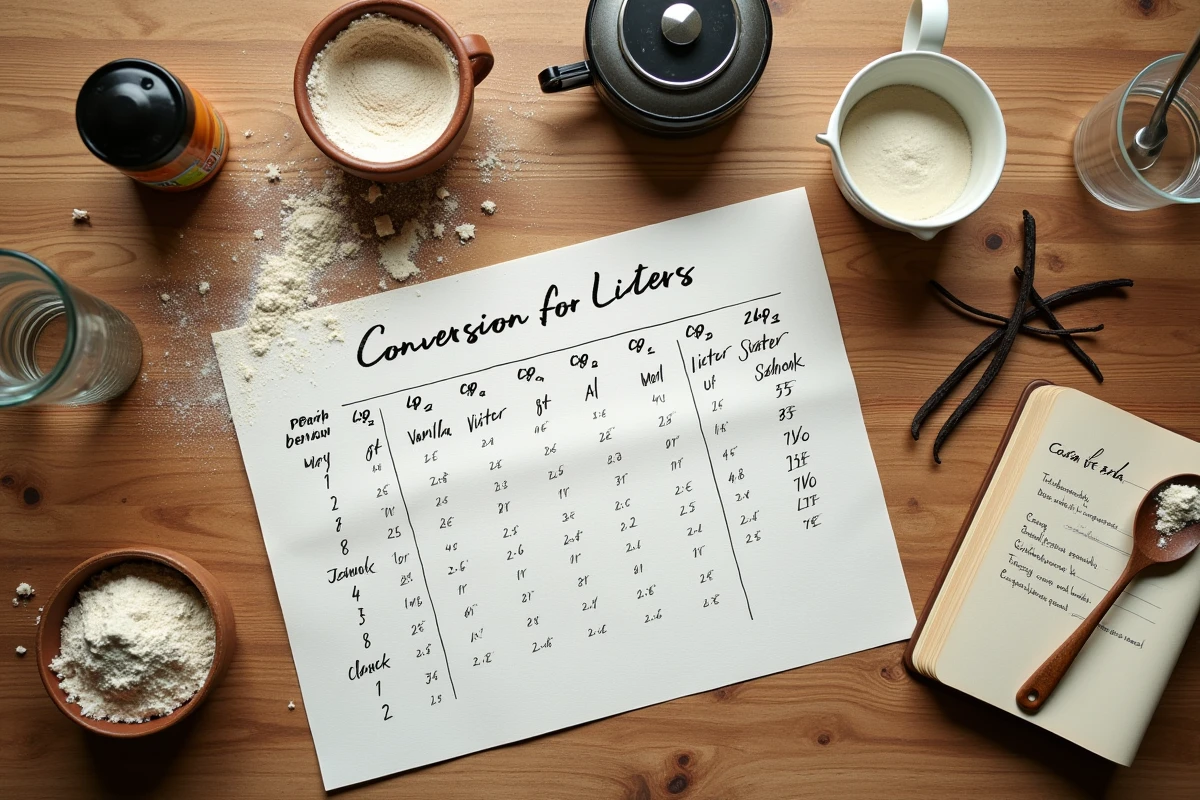
You don’t have a scale and the table isn’t displayed on your fridge. A simple approach allows you to manage with a measuring cup and three memorized benchmarks.
- For water, milk, and liquid cream: 1 mL = 1 g (the density is close to 1)
- For oil: subtract about 10% from the volume read on the measuring cup to get the weight in grams (100 mL of oil gives about 90 g)
- For flour: divide the volume in mL by 1.5 to estimate the weight (100 mL of flour gives about 60 to 65 g)
- For granulated sugar: subtract about 15% from the volume (100 mL gives about 85 g)
These four benchmarks cover the vast majority of conversions in everyday cooking. They do not replace a precision scale for technical baking, but they avoid major errors when you improvise.
One last practical point: never pack a dry ingredient into a measuring cup unless the recipe explicitly asks for it. Packing changes the apparent density and skews the conversion. Pour, level with the back of a knife, measure.
The gram-liter conversion is based on a simple principle, density, but this principle applies differently to each ingredient. Memorizing the benchmarks for water, oil, flour, and sugar covers most situations in cooking. For less common ingredients, the Ciqual database from ANSES remains a reliable and accessible online resource.