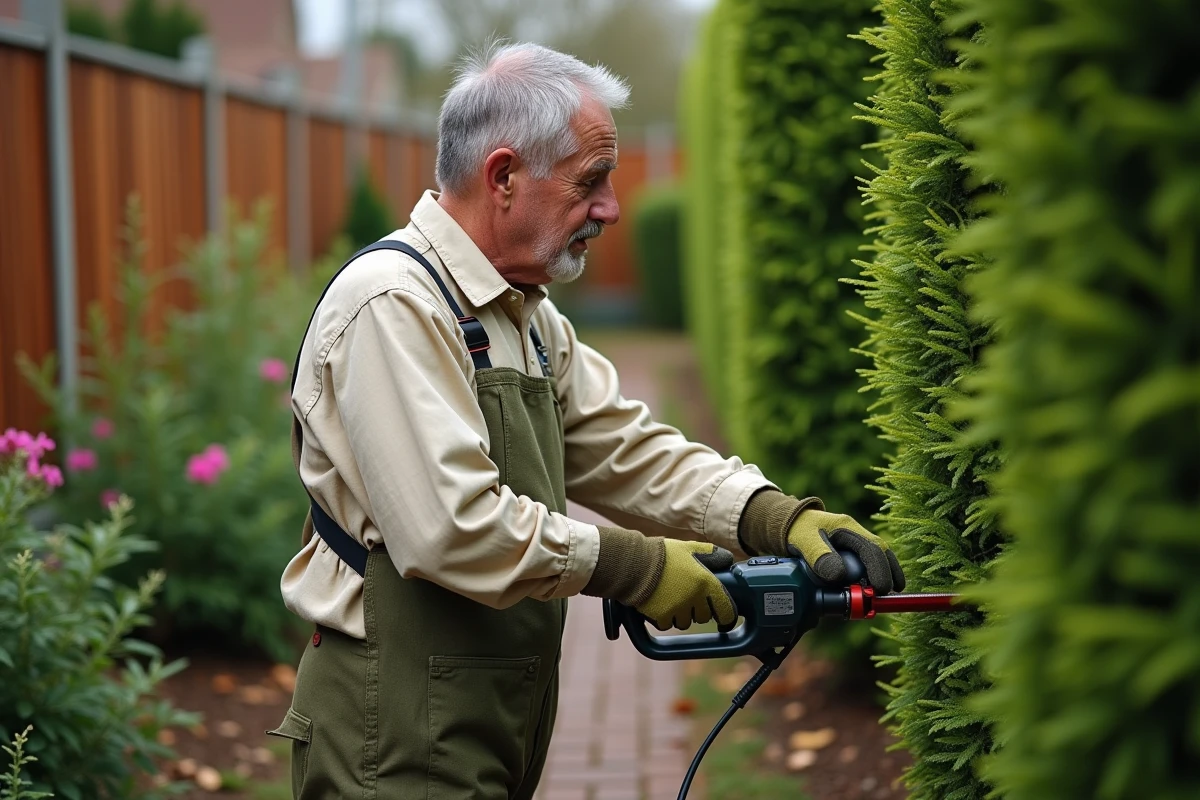
A two-meter hedge of thuja that hasn’t been trimmed for a year should not be treated like a boxwood border. The diameter of the branches, the height to be reached, and the frequency of cuts determine the type of hedge trimmer suitable, well before the question of budget or brand. Choosing the right hedge trimmer starts with what you see in the garden.
Tooth spacing and cutting diameter: the often-overlooked criterion
People often start by comparing engines or brands. The factor that truly conditions cutting efficiency is the spacing between the teeth of the blade. The wider the spacing, the more the hedge trimmer can handle larger diameter branches without getting stuck.
For a hedge of soft-leaved plants (privets, young laurels), a reduced spacing is sufficient and provides a clean finish. On an old hedge of cypress or thuja with hard wood, a more generous spacing is needed; otherwise, the machine struggles, and the blades wear out prematurely.
To delve deeper into the technical characteristics of different models, detailed comparisons can be found on taillehaie.info, which helps to compare product sheets before making a purchase.
The length of the blade also plays a direct role. A short blade (around 40 cm) is suitable for topiary and small decorative hedges. For linear hedges exceeding ten meters, a long blade reduces the number of passes and saves considerable time. However, it makes the device heavier and complicates precision cuts.

Battery, electric, or gas hedge trimmer: choose based on terrain constraints
The choice of power source is not made in a vacuum. It starts with the configuration of the garden.
Access to an electrical outlet
If the hedge runs along the house or garage, a wired electric hedge trimmer remains the lightest and cheapest solution. You plug it in, you trim, no battery to recharge. The limitation appears as soon as you move away: beyond a 30-meter extension cord, power loss is noticeable, and the cable becomes a constant nuisance.
Large garden or plot without electricity
The battery model then makes perfect sense. Feedback on actual autonomy varies by brand, but a decent lithium-ion battery lasts for a full trimming session for a medium-sized garden. There is a recent trend towards interchangeable battery systems between tools from the same manufacturer, which reduces the overall cost if you already own a blower or brush cutter from the same range.
Dense hedges over long lengths
The gas model retains the advantage for heavy-duty tasks: very thick hedges, linear stretches of several dozen meters, hard wood. The power is superior, and autonomy is limited only by the tank. The downside: weight, noise, engine maintenance (spark plug, filter, oil-gas mixture), and emissions. For use two to three times a year on a small hedge, it’s oversized.
- Wired electric: light, economical, suitable for hedges near an outlet, limited by the cable.
- Battery: versatile, quiet, ideal for medium gardens without direct electrical access.
- Gas: powerful and enduring, reserved for dense hedges or large properties.
Weight and ergonomics of the hedge trimmer: what matters after twenty minutes of cutting
On the technical sheet, we look at the weight when empty. In practice, you hold the device with arms extended throughout the session. Muscle fatigue depends as much on weight distribution as on total weight.
A well-balanced model with a rotating handle allows you to trim the top and sides of the hedge without twisting your wrists. This is a point to test in-store if possible, because two devices of the same weight can offer very different comfort depending on the position of the handles.
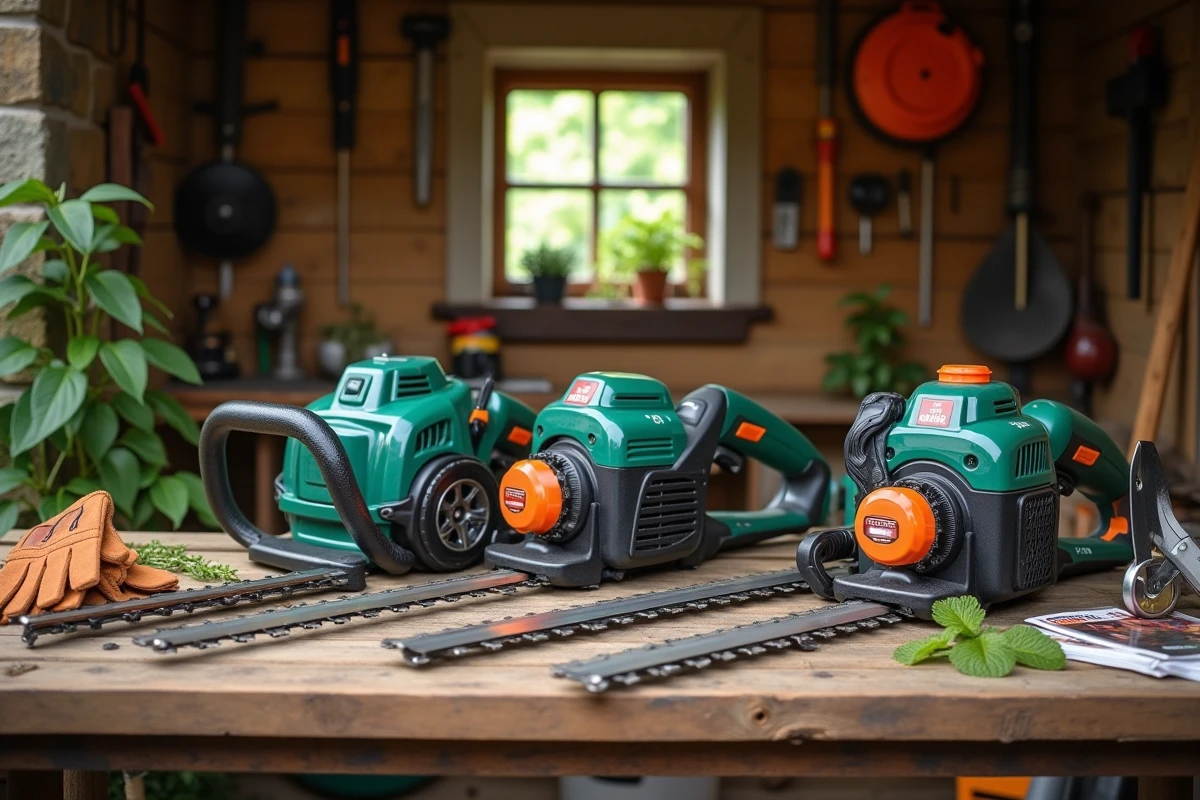
For tall hedges, a pole hedge trimmer avoids the need for a ladder. You gain safety, but the leverage effect at the end of the pole quickly tires the shoulders. A carrying harness then becomes an almost essential accessory.
- Check the position and orientation of the rear handle (fixed or pivoting).
- Prefer a model with vibration dampening if you trim for more than an hour.
- For hedges exceeding two meters, consider a telescopic pole rather than a ladder.
Safety and blade maintenance: two areas not to improvise on
The blade of a hedge trimmer operates with rapid reciprocating motion. A quick blade stop after releasing the trigger is a non-negotiable safety criterion. We also check for the presence of a protective shield at the end of the blade, which prevents accidental contact with a wall or fence.
On the maintenance side, a blade that is not cleaned after each use accumulates sap, which accelerates corrosion and reduces cutting quality. A wipe with a cloth soaked in resinous product after each session is sufficient. Sharpening is done once or twice per season depending on usage intensity, ideally with a flat file to maintain the original angle of the teeth.
For gas models, we add checking the air filter, replacing the spark plug, and periodic oil changes. These operations condition the longevity of the engine and take only a few minutes if done regularly.
Choosing a hedge trimmer boils down to three concrete questions: what branch diameter are you cutting, how far from the house are you working, and how long can you hold the device in the air. Answering these three points before looking at prices avoids most bad purchases.