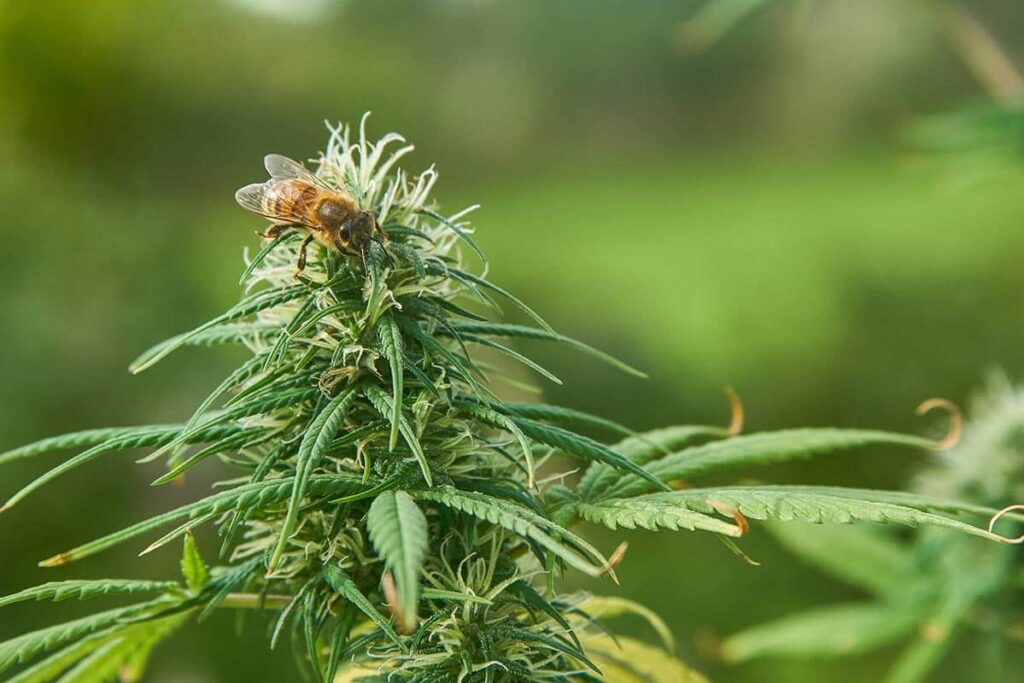
Bees are crazy about cannabis, a new study from Cornell University, published in Environmental Entomology, has shown that more and more bees are “frequenting” hemp plants in certain regions of the United States, where production has significantly increased even following widespread legalization.
According to the researchers, bees have found some relief in these crops, recovering from the stress caused by the loss of their natural habitat due to the gradual expansion of large-scale intensive agriculture, which has both affected the decline of plant diversity and introduced a wide use of pesticides and chemical insecticides, persistent pathogens, and parasites.
The crops in question, rapidly expanding on the American agricultural scene, are those of industrial hemp, Cannabis sativa, which offers a unique floral resource to bees in the landscapes and has supported up to 16 different species of bees:
“We identified all bee visitors at the species level and found that hemp supported 16 different species of bees.”
These crops are only wind-pollinated, and hemp has no nectar but produces abundant pollen during a period of floral scarcity in agricultural landscapes, at the end of summer, pollen that the bees in question are crazy about.
The researchers understood that hemp therefore has the potential to represent a fundamental nutritional resource for a diverse bee community and that it can be useful in supporting “pollination services at the agro-ecosystem level for other landscape crops.”
Therefore, as hemp cultivation expands, “farmers, land managers, and policymakers should consider its value in supporting bee communities and take into account its attractiveness to bees when developing weed management strategies.”
In short, cannabis could save the bees, and this is great news given that in 2016, bees in the United States were officially declared endangered, and over the past five years, out of 10 million hives, about 2 million have disappeared each year, with 200,000 alone in Italy.
You might also be interested in:
- Bee deaths: a shocking study shows that common fungicides are (also) responsible for this death
- Why are bees and bumblebees disappearing?
- The death of bees: the fault of neonicotinoid pesticides, confirmation from Harvard
Tag: More info on CBD