
Brigitte Buc is a prominent figure in contemporary French theater whose name regularly appears in the programs of regional companies. A playwright, actress, and director, she has built a career where literary training and stage practice mutually enrich each other. While much research focuses on her age, no reliable public source mentions her exact date of birth, making any numerical claim speculative.
Training at the Rouen Conservatory and Master’s in Literature: a rare dual foundation
In the French theatrical landscape, it is rare to encounter paths that so thoroughly combine academic work on text and physical learning of performance. Brigitte Buc first studied at the Rouen Conservatory, in Jean Chevrin’s class. This initial training provided her with the tools for stage acting, diction, presence, and engagement with a live audience.
At the same time, she pursued a university degree in modern literature at Jussieu, culminating in a master’s thesis dedicated to Nathalie Sarraute. This choice is far from trivial. Sarraute, with her “tropisms” and attention to psychological micro-movements, imposes a reading of the text where every word carries weight. When one works on this author for several years, one develops a particular sensitivity to the rhythm of sentences, the silences between lines, and what lies beneath the surface of dialogue.
To learn more about Brigitte Buc’s age and the major milestones of her biography, the available sources primarily confirm the richness of this dual path rather than a precise date of birth.
This intersection between conservatory and university has produced a profile of a playwright who writes with the stage in mind. Her plays bear the mark of a practitioner of performance as much as that of a demanding reader. This distinction is noticeable in reading: the stage directions are functional, the dialogues breathe like musical scores, and the characters exist in space before they exist in the plot.
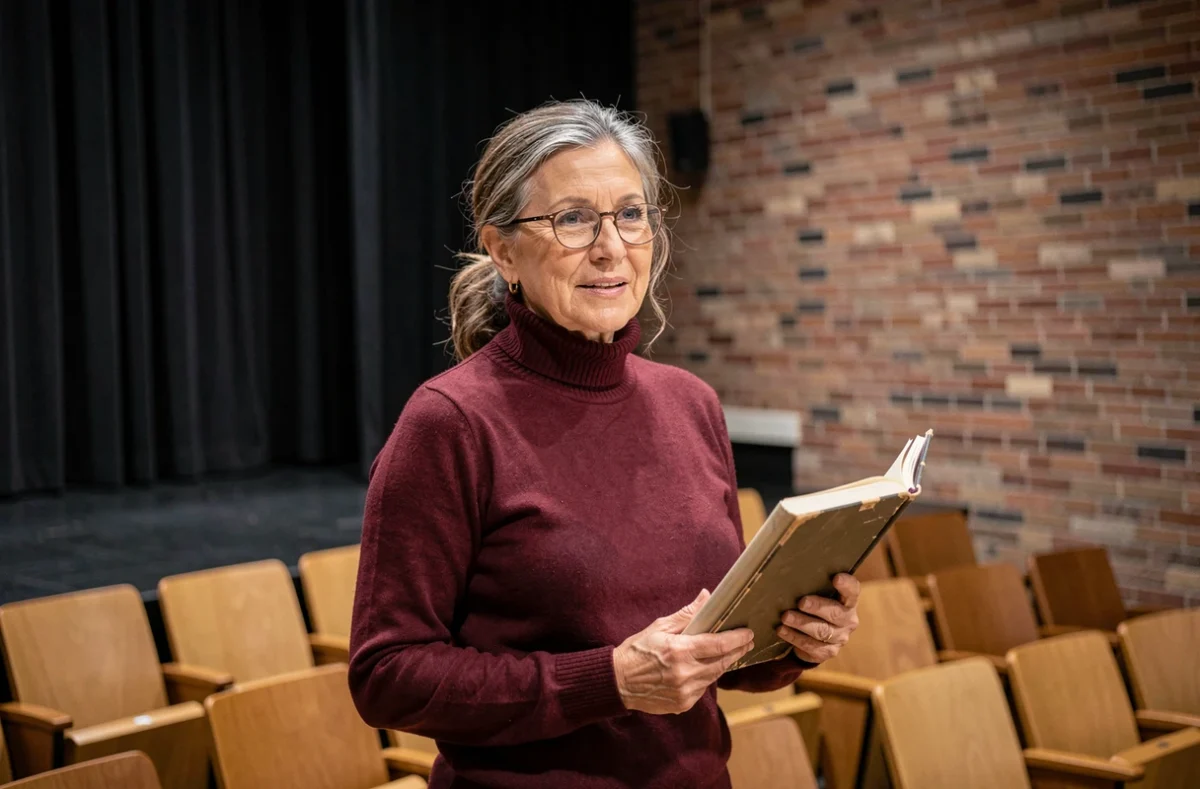
Actress and Director: Significant Collaborations
Brigitte Buc has not built her career in solitude. Two significant collaborations have shaped her practice. She worked with Joël Dragutin at Théâtre 95, a venue in Cergy-Pontoise that has always championed contemporary writing. The experience in a Parisian suburban structure, facing diverse audiences, confronts an artist with realities that the central Parisian theaters do not always reveal.
She also collaborated with Xavier Marchesci at the Studio Théâtre de Stains, a place rooted in the local fabric of Seine-Saint-Denis. These two experiences share a common point: they are situated outside the most visible circuits, in theaters where the relationship with the audience is direct and where production means require an economy of staging.
Directing as a Natural Extension
At the turn of the 2000s, Brigitte Buc took the leap into directing. When one has been an actress for years and writes one’s own texts, directing actors becomes a logical extension. One knows the constraints of acting from the inside, understands what a line demands from the body, and anticipates the difficulties of movement or addressing the audience.
This triple role (playwright, actress, director) remains uncommon in contemporary French theater. It gives Brigitte Buc an artistic autonomy that partly explains why her texts travel well beyond their initial creation.
Plays Revived by Touring Companies: A Sign of Dramaturgical Strength
A play that remains in the drawer after its creation has not succeeded in its challenge. Brigitte Buc’s plays experience a different fate: they circulate among regional and touring troupes, sometimes far from major metropolitan areas. Her texts can be found in programming in Lorraine, in Allier, in municipal venues, or local festivals.
This phenomenon deserves attention. For an independent company to choose a text, several practical criteria come into play:
- The number of characters must remain manageable for a small troupe, often composed of three to six actors
- The text must work with a lightweight set, transportable in a truck or van
- The themes must resonate with audiences who do not necessarily frequent Parisian theaters, featuring recognizable situations
- The language must be accessible without being simplistic, allowing for lively performance without overwhelming the audience with references
Brigitte Buc’s plays clearly tick these boxes. Texts like “Les Sœurs Bienaimé” address universal themes (family, forgiveness) in a comedic register that opens the door to a wide audience. This type of writing requires precise know-how: too light, the play falls into entertainment without substance; too literary, it loses casual spectators.

Brigitte Buc President of the SACD: A Commitment to Living Authors
Beyond the stage, Brigitte Buc holds the presidency of the SACD (Société des auteurs et compositeurs dramatiques). This role is far from honorary. The SACD manages copyright in live performance, cinema, and audiovisual media. Presiding over this institution means defending the economic interests of thousands of authors, negotiating with distributors, and addressing issues of remuneration and protection of works.
Her profile as a practicing playwright adds a particular color to this mandate. When the person presiding knows the cost of a regional tour, the reality of a rights transfer contract for a small venue, or the working conditions of a touring company, the decisions do not stem from the same assumptions as those of a leader from the audiovisual or film sectors.
A Role of Public Representation
As president, Brigitte Buc also speaks publicly on behalf of the author community. She pays tribute to figures in the profession, engages in debates concerning contemporary creation. This institutional role extends a ground-level commitment: one does not transition from the stage of the Studio Théâtre de Stains to the presidency of the SACD without an intimate knowledge of the sector’s realities.
Brigitte Buc’s journey outlines a coherent trajectory, from the Rouen Conservatory to the presidency of the SACD, passing through suburban stages and regional tours. Her plays continue to be performed by companies seeking solid and playable texts. This may be the best indicator of the value of a dramatic work: not the awards received, but the number of troupes that decide, year after year, to present it to an audience.