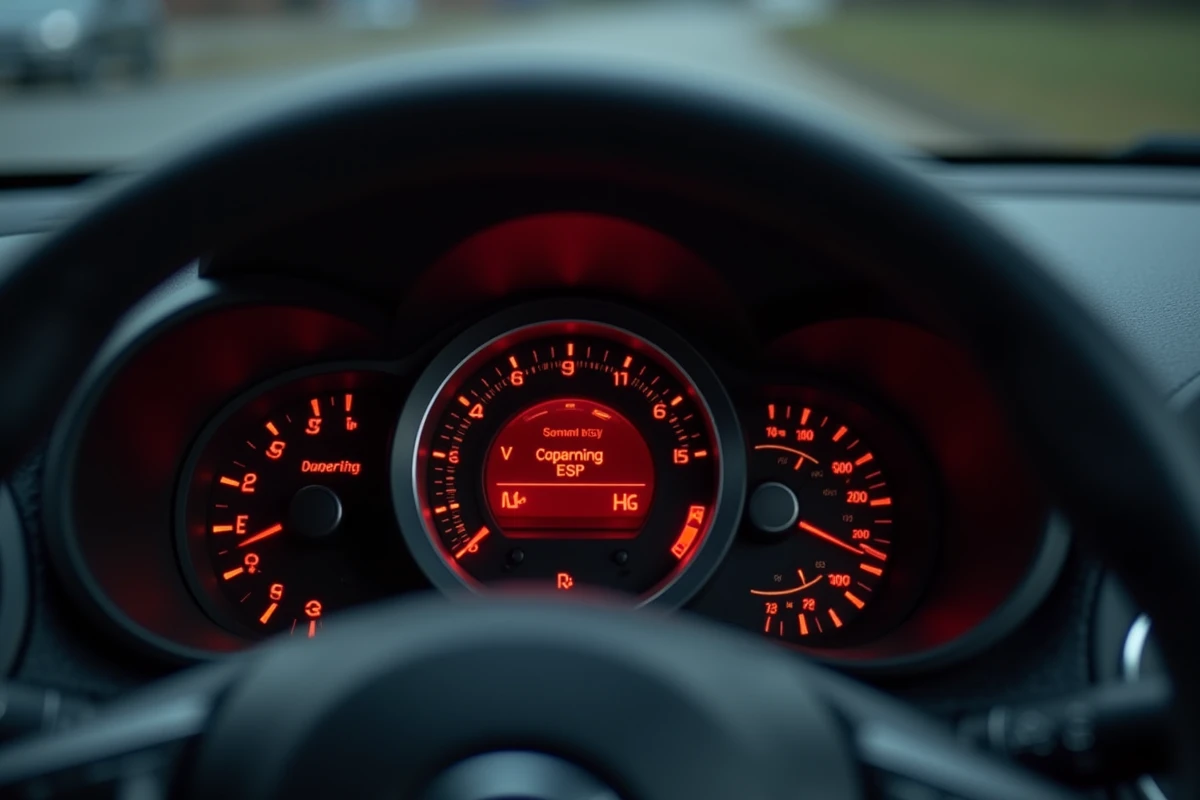
We are driving calmly in our Nissan Juke when suddenly the red engine light comes on along with the ESP warning light. The instinct is to pull over, turn off the ignition, and restart, hoping everything will turn off. Sometimes it works. Often, the two lights come back on after a few kilometers. Understanding why these two alerts appear together on the dashboard helps avoid unnecessary diagnostics or, worse, driving with an untreated real problem.
CAN Network and the Link Between Engine Light and ESP on Nissan Juke
On the Nissan Juke, the engine control unit and the ESP control unit communicate continuously via the CAN (Controller Area Network). When the engine goes into limp mode, the available torque drops sharply. The ESP control unit then receives inconsistent torque values compared to what it expects.
Its logical reaction: to deactivate or limit its intervention because it can no longer manage the vehicle’s stability based on reliable data. Thus, we end up with two warning lights illuminated for a single underlying problem.
Nissan has published technical bulletins (TSB ref. NTB17-046b and MA-ES-19-011) regarding first-generation Jukes. These documents report faults in the steering angle sensor and brake pressure sensor that can simultaneously illuminate the ESP and engine lights due to inconsistencies in the values exchanged over the CAN network.
These faults do not necessarily generate an apparent ABS alert. To better understand the red engine light and ESP on Nissan Juke, this communication logic between control units is the starting point for diagnostics.
Clogged DPF on 1.5 dCi K9K Engine: A Common Cause of Limp Mode
On Jukes equipped with the 1.5 dCi engine (K9K block shared with Renault), a scenario frequently recurs in workshop feedback. The particulate filter gradually clogs, especially in urban use with short trips that do not allow for automatic regeneration.
A clogged DPF forces the engine into limp mode, which limits engine power. The red engine light comes on. Subsequently, the ESP deactivates because the stability control unit can no longer rely on predictable engine torque.
The typical symptoms in this case are:
- The vehicle gradually loses power, then the red engine light illuminates on the dashboard
- The ESP light appears in the following seconds, sometimes accompanied by a slight jolt
- A restart may temporarily turn off the lights, but they return as soon as the engine goes back into limp mode
A diagnostic check with reading of fault codes (DTC) can confirm if the DPF is the issue. Codes related to the differential pressure of the filter or incomplete regeneration are often found.
Battery and Alternator: Electrical Failures That Illuminate the Entire Dashboard
On Jukes produced before the 2014 facelift, a well-documented issue concerns brief voltage drops. An aging battery or a tired alternator can cause the simultaneous illumination of the red engine light and the ESP/ABS lights, without any actual mechanical failure being present.
The CAN network is sensitive to voltage variations. A micro-power cut is enough to lose synchronization between control units. The system then records fault codes as a precaution.
The trap is that these faults disappear after a battery check, a full recharge, and a code reset. One might think the problem is resolved, but if the battery or alternator is not replaced, the lights return a few days or weeks later. Check the battery voltage before any other diagnostics: this is the quickest and least expensive step to eliminate this possibility.

Nissan Juke Diagnostics: Sensors to Check First
When the battery is healthy and the DPF is fine (or on a gasoline engine), the problem often comes from a faulty sensor. On the Juke, three sensors deserve particular attention during diagnostics.
Steering Angle Sensor
This sensor informs the ESP control unit of the direction the driver is giving to the wheels. If it sends inconsistent values, the ESP goes into fault mode. The engine light may illuminate in parallel if the engine control unit receives contradictory data via the CAN network.
ABS Wheel Sensors
The wheel speed sensors are shared between the ABS and ESP systems. A dirty sensor, damaged wiring, or excessive air gap relative to the hub is enough to trigger the alert. Feedback varies on this point: some owners resolve the issue with a simple cleaning, while others need to replace the sensor.
Brake Pressure Sensor
Mentioned in Nissan’s technical bulletins, this sensor transmits data to the ESP control unit to modulate braking. An erratic signal from this sensor lights up the ESP without necessarily triggering the ABS, complicating diagnostics if one is only looking at the braking system.
What to Do When the ESP and Engine Lights Illuminate Together
The priority is to distinguish a temporary electronic fault from a real mechanical failure. A few steps can quickly sort things out:
- Turn off the ignition, wait a minute, restart. If the lights disappear and do not return after about thirty kilometers, the fault was probably related to a micro-electronic bug
- Check the battery condition with a multimeter or at an auto parts store. A voltage lower than normal at rest points to an electrical problem
- Have the fault codes read with an OBD scanner. The codes stored in the engine control unit and the ESP control unit help pinpoint the failure without disassembling anything
- Avoid driving for long with the red engine light on. Limp mode protects the engine, but the absence of ESP reduces the vehicle’s active safety, especially on wet roads
On forums and support groups, many Juke owners report that a visit to the dealership with the Nissan Consult tool sometimes detects “zero faults” even though the lights were on the day before. If the fault is intermittent, request the reading of stored codes, not just active codes. Temporary faults remain stored in the control unit’s history and guide diagnostics in the right direction.